


Problematic Avians
While there are several species of exotic birds in The Bahamas, a few are known for their invasive tendencies.
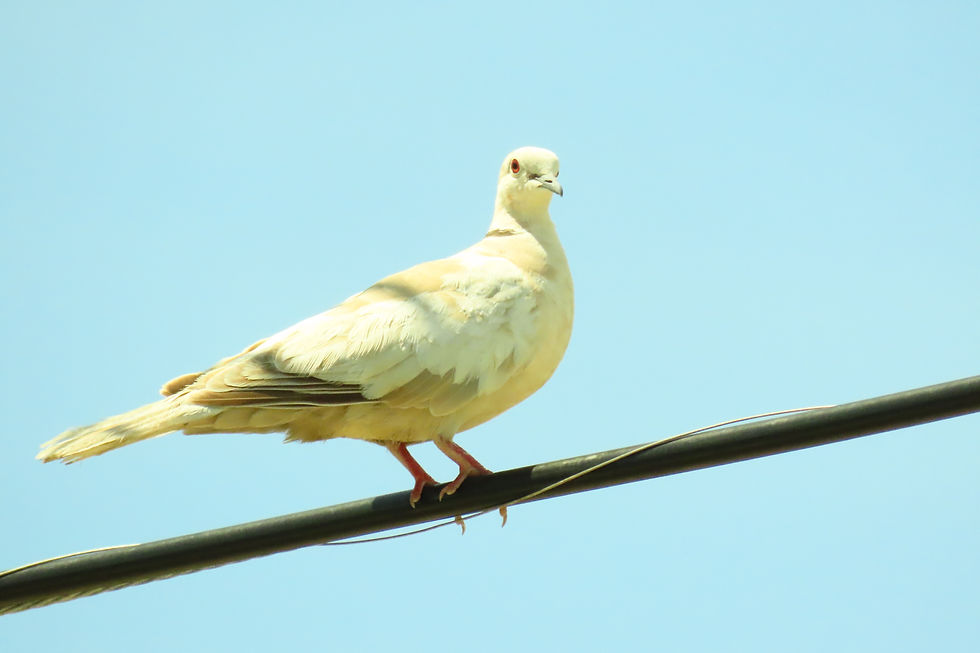
The Eurasian Collared Dove is a species that originated in Eurasia, namely in India, Myanmar, Pakistan, and Sri Lanka. This species is one of many that has benefitted from anthropogenic disturbance. It made its debut in the New World in the 1970s when some birds escaped from a local breeder during a burglary on New Providence. The breeder later released the remaining individuals which quickly started breeding and expanding its range throughout The Lucayan archipelago.

Eurasian Collared Dove
This was also assisted by another release in Abaco in the 1980’s where the justification was that they would decrease the hunting pressure on the White-crowned Pigeon, a highly sought after game bird. Since its release, the Eurasian collared dove has invaded and established itself throughout the West Indies , the US and parts of Central America. For a more detailed account on this species, please click here .

House Sparrow
House Sparrow
Another non native species that has established itself in The Bahamas and considered a nuisance species is the House Sparrow. Originally from Eurasia, it was introduced into The Bahamas in 1875 and has since spread throughout The Lucayan Archipelago. For a more detailed account on this species, please click here
Rock Pigeon
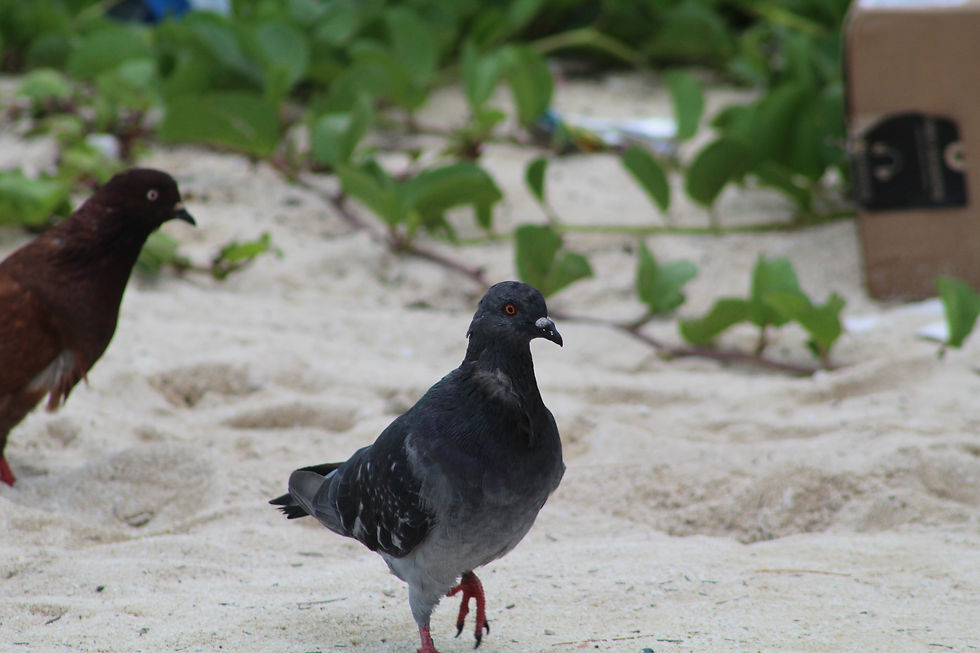
The Rock Pigeon is a common exotic species in The Bahamas. This species is native to North Africa, Europe and Southern Asia. The Rock Pigeon inhabiting our islands are feral with high levels of plumage variation. The Rock Pigeon is among the most studied animal species on earth and have been used in the study of flight, thermoregulation, evolutionary biology, and sensory perception, just to name a few areas. For a more detailed account on this species, please click here

Rock Pigeons

European Starling
European Starling
The European Starling is native to Eurasia, the Middle East and North Africa. It was introduced into North America in 1890 and 1891. During that time, 100 individuals were intentionally released in Central Park, New York City. They were also introduced into The Bahamas.
Unlike pigeons and house sparrows, European Starlings are cavity nesters and are fierce competitors for nest cavities. This leads to native cavity nesters such as Kestrels, Bahama Swallows, and La’Sagras Flycatchers having to compete and often being outcompeted by these invasive birds. European Starlings have been observed on New Providence, Grand Bahama, Abaco, Andros, Exuma, Eleuthera, and San Salvador. For a more detailed account on this species, please click here.
Chicken
The most abundant bird species on earth and also one of the most important meat animals is the chicken. Chickens are the domestic descendants of the Red Jungle Fowl, a species that originates in Southeast Asia. Since its introduction into The Bahamas and the West Indies in the late 15th century, the chicken is a common sight throughout the region. Unfortunately, this species is invasive.
Chickens have very catholic diets and are known for scratching the ground and leaf litter in search of invertebrates and small vertebrates that they eat.
These leaf litter and soil organisms, however, are essential for the health of our forests and soil. A flock of chickens can decimate the local population of subterranean organisms in just a few days. Bahamian animals that are under threat of this include various species of beetles and other insects, geckolets, myriapods, and blind snakes.
For a more detailed account of the domestic chicken, please click here.
Domestic Chicken

fact sheets

COMING SOON!
COMING SOON!
COMING SOON!
COMING SOON!
posters
COMING SOON!
COMING SOON!
COMING SOON!
COMING SOON!

photo gallery
 |  |  |
|---|---|---|
 |

resources
Cabe, P. R. 2020. European Starling (Sturnus vulgaris), version 1.0. In Birds of the World (S. M. Billerman, Editor). Cornell Lab of Ornithology, Ithaca, NY, USA.
Lowther, P. E. and C. L. Cink. 2020. House Sparrow (Passer domesticus), version 1.0. In Birds of the World (S. M. Billerman, Editor). Cornell Lab of Ornithology, Ithaca, NY, USA.
Lowther, P. E. and R. F. Johnston. 2020. Rock Pigeon (Columba livia), version 1.0. In Birds of the World (S. M. Billerman, Editor). Cornell Lab of Ornithology, Ithaca, NY, USA.
McGowan, P. J. K. and G. M. Kirwan. 2020. Red Junglefowl (Gallus gallus), version 1.0. In Birds of the World (J. del Hoyo, A. Elliott, J. Sargatal, D. A. Christie, and E. de Juana, Editors). Cornell Lab of Ornithology, Ithaca, NY, USA.