


Botanical Bullies
Like invasive animals, invasive plants have significant ecological impacts on native ecosystems. These species often possess novel traits—such as allelopathic chemicals—that inhibit the growth of surrounding vegetation. In The Bahamas, several introduced plant species exhibit invasive characteristics, including Snake Plant (Dracaena trifasciata), Philodendron spp., and Jaw Plant (Tradescantia fluminensis). These plants can form dense monocultures in forest understories, displacing native vegetation and disrupting foraging habitats for understory fauna, such as the Key West Quail-Dove (Geotrygon chrysia).
Native plant communities and soil biota often provide resistance to the establishment of non-native species. The soil microbiome, a diverse and dynamic ecosystem, can inhibit invaders through microbial competition and other biotic interactions. However, invasive species are often highly adaptable and may overcome these defenses, resisting pressures from native microbes, invertebrates, and plant competitors.
Deforestation and land clearing remove many of these natural resistances, creating disturbed environments that facilitate the establishment and spread of opportunistic invasive plants. As a result, several non-native plant species have become well-established in The Bahamas and are now recognized as highly invasive. Here are a few examples:

Casuarina
Casuarina
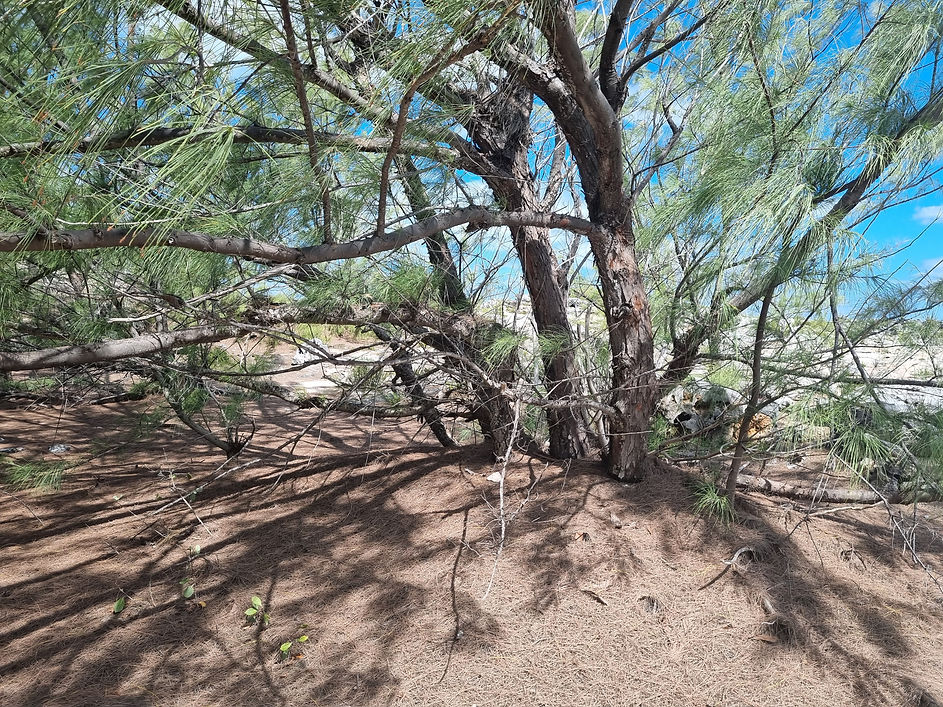
Casuarina first arrived in the USA from France in 1898 and were planted along beaches and near homes to act as a wind break against strong winds and Hurricanes. It was also introduced into West Indies in the late 1800s as an ornamental and like in Florida, was used (erroneously) to help stabilize eroding beaches. It was recorded in The Bahamas in 1889, but was most likely established before then.
Casuarinas are one of the worst invasive plants on earth and at least two species have been oserved in The Bahamas: Casuarina equisetifolia and C. glauca
Casuarina produce an allelochemical called Chapelin with inhibits the growth of other plants around it. Where there are casuarina stands, the soil pH is lower, and there is significantly less soil potassium and phosphorus. Contrary to historical belief, Casuarinas also cause sand dune erosion as their fibrous root system does not help to stabilize the sand. During hurricanes, they cause much of the sand to be washed away, destroying this important coastal ecosystem.
Hawaiian Seagrape
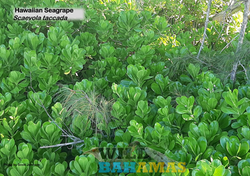
Hawaiian Seagrape (Scaevola taccada) was first observed on the island of Andros in 1980 by Donavan Correll. Since then, it has spread throughout The Bahamas. Hawaiian Seagrape originates in Australia but has been transported worldwide. One of the reasons why Hawaiian seagrape is problematic is because it can hybridize with our native Scaevola (S. plumeri). This hybridization contaminates the genetic line of our native species which can lead to genetic extinction of native populations.

Hawaiian Seagrape

Melaleuca
Melaleuca
Melaleuca (Melaleuca quinquenervia) was first observed in the early 1980s on the island of Andros near Fresh Creek Airport. However, a 2004 survey found that the species was also found on other islands such as New Providence and Grand Bahama prior to Andros discovery. Melaleuca originates from Australia and when established, forms dense wetland forests with thick canopies with little understory.
Brazilian Pepper
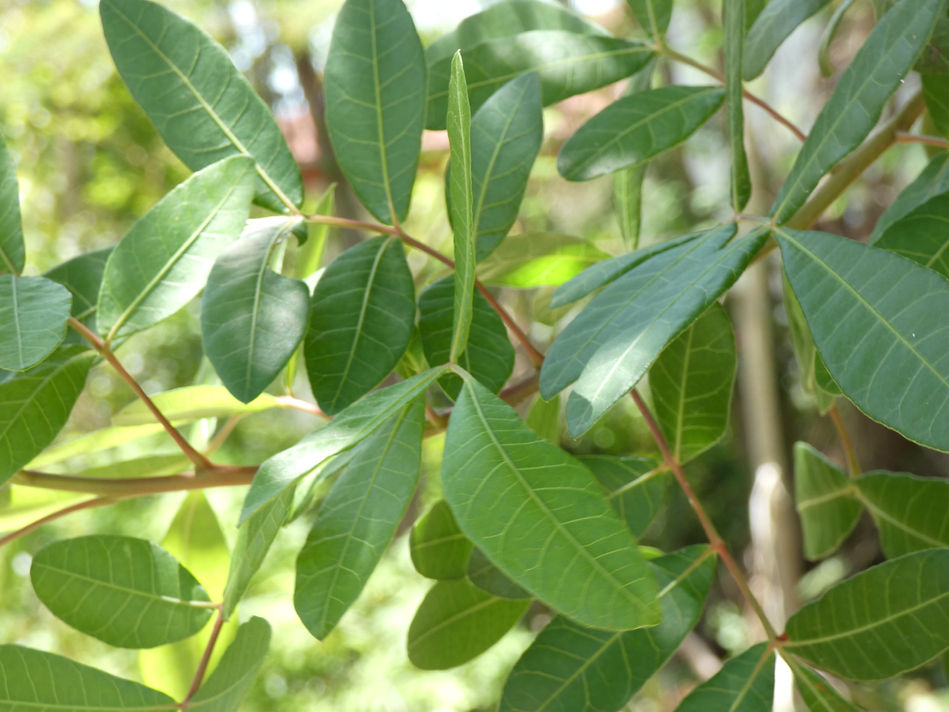
Brazilian Pepper (Schinus terebinthifolia) is a plant that is native to South America, namely the countries of Argentina, Paraguay, and Brazil. Like Poison Ivy, Poisonwood, Poison Sumac and Mango, it is in the family Anacardiaceae. Brazilian Pepper is an aggressive species that forms thick, monocultures, preventing or severely decreasing native vegetation in the area.
Brazilian Pepper was introduced into Florida between 1840 and 1891 as an ornamental. The bright red berries are very attractive to frugivorous animals such as birds which aid in its dispersal and invasive nature. In The Bahamas, this plant is widespread especially in disturbed areas like farmlands.
Despite it being an invasive plant, Brazilian Pepper has been shown to have medicinal properties. A 2020 study published in the journal “Industrial Crops and Products”, assert that this species is rich in bioactive compounds and has shown to have some effectiveness against the multi-drug resistant bacteria Staphylococcus areus. Other research published in the Journal “Nature” show that lectin, a chemical isolated from Brazilian Pepper leaves inhibits S. areus cell division.

Brazillian Pepper

fact sheets

COMING SOON!
COMING SOON!
COMING SOON!
COMING SOON!
posters
COMING SOON!
COMING SOON!
COMING SOON!
COMING SOON!
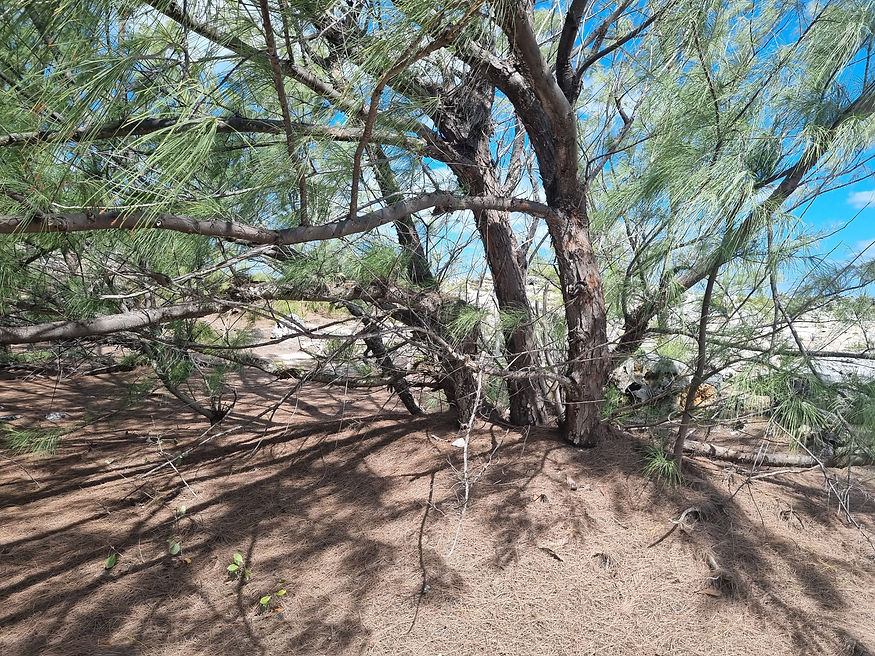
photo gallery
 |  |  |
|---|

resources
Berman, M.J. and Pearsall, D.M., 2020. Crop dispersal and Lucayan tool use: Investigating the creation of transported landscapes in the Central Bahamas through starch grain, phytolith, macrobotanical, and artifact studies. Journal of Field Archaeology, 45(5), pp.355-371.
Buehler, C.P., 2010. Soil modification and potential allelopathy: An investigation into how the invasive Casuarina equisetifolia L.(Australian pine) modify their environment. Mississippi State University.
Eshbaugh, W.H., 2014. The flora of the Bahamas, Donovan Correll, and the Miami University connection. The Botanical Review, 80, pp.184-203.
Gardiner, J. and Brace, L.J.K., 1889. Provisional list of the plants of the Bahama Islands. From the Proceedings of the Academy of Natural Sciences.
Leakey, C. and Roberts-Nkrumah, L.B., 2016. The introduction of the breadfruit [Artocarpus altilis (Parkinson) Fosberg] to the West Indies-The role of Sir Joseph Banks. Tropical Agriculture, 93.
Potgieter, L.J., Richardson, D.M. and Wilson, J.R., 2014. Casuarina: biogeography and ecology of an important tree genus in a changing world. Biological Invasions, 16, pp.609-633.
Pratt, P.D., Rayamajhi, M.B., Silvers, C.S. and Ferriter, A.P., 2007. Naturalization and biomass allocation of the invasive tree Melaleuca quinquenervia in wetlands of the Bahamas. Nat. Hist, 41, pp.1-68.
Sealey, N., 2006. The cycle of Casuarina-induced beach erosion—a case study from Andros, Bahamas. In The 12th Symposium on the Geology of the Bahamas and Other Carbonate Regions (2004). San Salvador, Bahamas: Gerace Research Center.
Sealey, N.E., 2011. Casuarina-induced beach erosion revisited. In Proceedings of the 13th Symposium on the Natural History of The Bahamas. San Salvador (pp. 52-58). Bahamas: Gerace Research Center.
Wine, A., Understanding the Genetic Diversity of Scaevola taccada and Scaevola plumieri on Vieques, Puerto Rico.