


Evidence in EARTH
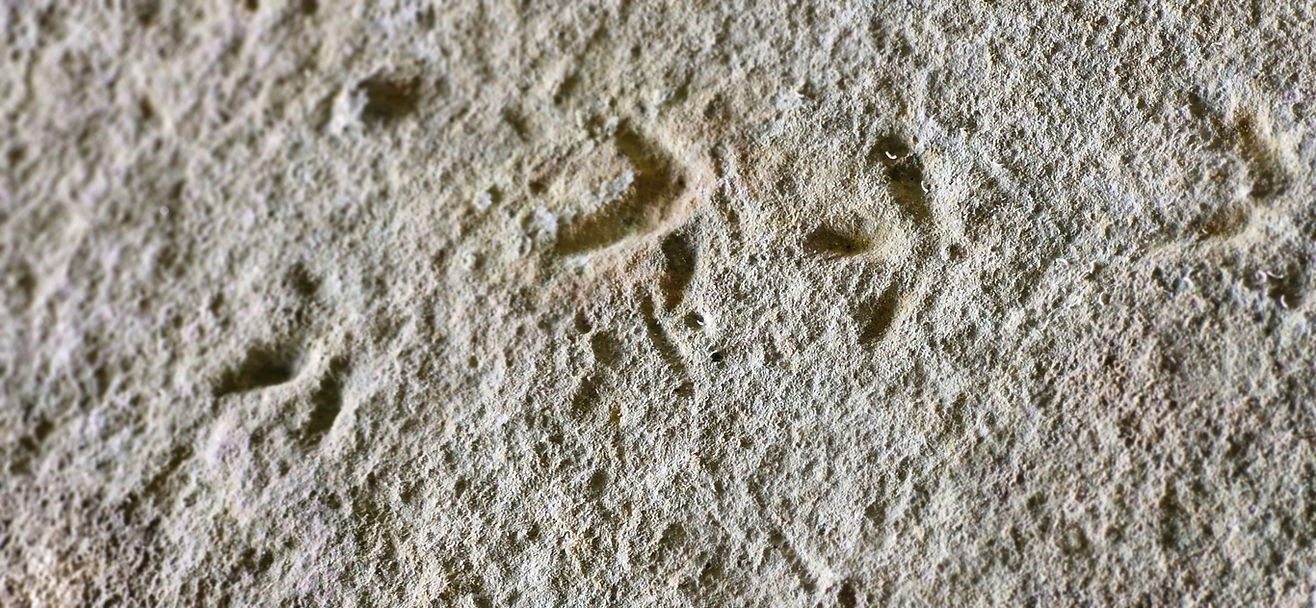
When we think of fossils, bones and shells are usually what comes to mind. However, there are other types of fossils that can give us more insight into how an animal may have lived and moved. One of these forms are trace fossils. A trace fossil is the fossil record of the activity of an organism without the actual organism. Good examples would be footprints, tail drags, and burrows.
In The Bahamas, trace fossils are all over the country and gives us a glimpse of animal life during the Pleistocene and Holocene. Many of the trace fossils reveal animals that lived in The Bahamas millennia ago and which are still around today. In San Salvador, for example, researchers found ghost crab burrows, solitary wasp burrows as well as the footprints of shorebirds and the tracks of soldier crabs (also known as land hermit crabs). In 2020, a spectacular trace fossil of a Bahamian rock Iguana burrow dating back to the Pleistocene (115 thousand years ago) was also found on San Salvador! Shorebird footprints were also found on Eleuthera and fossilized tail drags of Cuban Whiptails were found in the Ragged Island archipelago.
Beyond these charismatic animal fossils, the often overlooked yet equally captivating relics of the past include plant fossils. Although less common than animal fossils, the discovery of trace plant fossils, such as vegemorphs—fossilized tree roots, palm fronds, and trunks—has significantly contributed to reconstructing the environmental history of The Bahamas. Noteworthy findings extend across various islands, including Eleuthera, the Exuma Cays, New Providence, and Ragged Island."
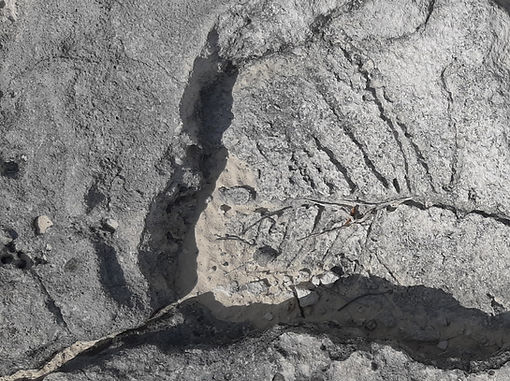
Palm trace fossil


fact sheets

COMING SOON!
COMING SOON!
COMING SOON!
COMING SOON!

posters
COMING SOON!
COMING SOON!
COMING SOON!
COMING SOON!

photo gallery
 |  |
|---|

resources
Kindler, P., 2008. Multiple sedimentary sequences, bird tracks and lagoon beaches in last interglacial oolites, Boiling Hole, North Eleuthera Island, Bahamas.
Martin, A.J., 2006. A composite trace fossil of decapod and hymenopteran origin from the Rice Bay Formation (Holocene), San Salvador, Bahamas. In 12th Symp. Geology of the Bahamas and Other Carbonate Regions (eds D. Gamble & RL Davis) (pp. 99-112).
Martin, A.J., Stearns, D., Whitten, M.J., Hage, M.M., Page, M. and Basu, A., 2020. First known trace fossil of a nesting iguana (Pleistocene), The Bahamas. Plos one, 15(12), p.e0242935.
Martin, A.J. and Whitten, M.J., 2015. First known fossil bird tracks (Pleistocene) on San Salvador island, Bahamas. Geologica Acta: an international earth science journal, 13(1), pp.63-68.