


Natural Barometers of marine ecosystems
The Earth is home to 359 extant species of seabirds, with 21 taxa use the West Indies as their breeding grounds. Seabirds play a pivotal role as biological indicators for marine ecosystems, offering invaluable insights into their health. The presence, or lack thereof, of seabirds and nesting sites serves as a vital barometer for identifying significant ecosystem issues, posing a broader threat to the livelihoods of those dependent on the ocean for sustenance.

Within The Bahamas, 17 species, including Brown Pelicans, Audubon Shearwaters, Magnificent Frigatebirds, Brown Boobies, White-tailed Tropicbirds, and Double-crested Cormorants, are known to breed. Click here to view full list. Seabird nesting sites are distributed across the archipelago, with notable breeding populations on islands like San Salvador. The northern Bahama islands of Bimini, Grand Bahama, Abaco, and the Berry islands are also home to substantial breeding populations, hosting a total of 113 colonies containing over 20,200 nests and more than 40,000 seabirds, along with other colonial waterbirds. This establishes the northern islands as a significant seabird nesting site in The Bahamas.
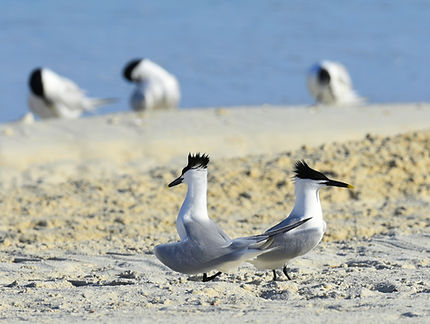
Regrettably, seabirds face considerable threats, being the most endangered group of birds globally. An estimated 31% of all seabird species are currently under threat, experiencing population declines. Persistent challenges, including climate change, developmental activities, and invasive species, pose constant risks to seabird populations.
Sargasso Shearwater
Sandwich Terns


fact sheets

COMING SOON!
COMING SOON!
COMING SOON!
COMING SOON!

posters
COMING SOON!
COMING SOON!
COMING SOON!
COMING SOON!

photo gallery
 |  |  |
|---|---|---|
 |  |  |
 |  |  |
 |  |  |
 |  |  |
 |

resources
Dias, M.P., Martin, R., Pearmain, E.J., Burfield, I.J., Small, C., Phillips, R.A., Yates, O., Lascelles, B., Borboroglu, P.G. and Croxall, J.P., 2019. Threats to seabirds: a global assessment. Biological Conservation, 237, pp.525-537.
Hayes, W.K., 2003. Can San Salvador's iguanas and seabirds be saved?. Bahamas Journal of Science, 11(1), pp.2-8.
Kushlan, J.A. and Steinkamp, M.J., 2007. Seabird nesting and conservation in the northern Bahamas. Waterbirds, 30(4), pp.613-623.
Piatt, J.F., Sydeman, W.J. and Wiese, F., 2007. Introduction: a modern role for seabirds as indicators. Marine Ecology progress series, 352, pp.199-204.