


Fantastic Frogs
The Bahamas is home to three species of native frogs.
The Cuban Tree Frog is our largest native species of amphibian. This species is sexually dimorphic, with females being larger than males, having a snout-to-vent length of 57 mm- 107 mm.
Although Cuban Tree Frogs can breed year-round, they breed mainly during the rainy season.
This species can be found in various habitats such as the pineland and coppice forests, wetlands, and residential areas.
Frogs reproduce via a behaviour called amplexus, where the males attract the females by croaking near or in a pond or other body of water. Once a female arrives, the male hops onto the female's back, holding her tight as she releases eggs, and he simultaneously fertilizes them through the release of his sperm.
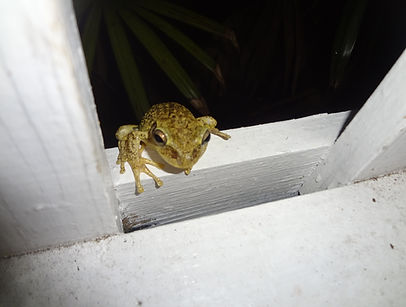
Cuban Tree Frog
Female Cuban Tree Frogs grow more slowly than males and may skip breeding events. This allows them to use that energy for growth and body maintenance and results in higher fecundity. Large females can produce over 15,000 eggs in a season. The number of eggs a female lays depends on size.
Cuban Tree Frogs are opportunistic predators and have been observed eating beetles, centipedes, spiders, cockroaches, snails, earthworms, and other frogs. Cannibalism has also been observed.
The Cuban Flat-headed Frog and Bahama Flat-headed Frog are at the smaller end of the spectrum, with the Cuban Flat-headed Frog being our smallest native frog, approximately 25 millimeters (0.98 inches).
These two species are in the genus Eleutherodactylus (meaning "free toes"). Eleutherodactylus is also the largest amphibian genus in the West Indies, accounting for over 84% of all West Indian species. The toes of these beautiful amphibians are not webbed like other species of frog. They inhabit a variety of habitats, including residents’ yards.
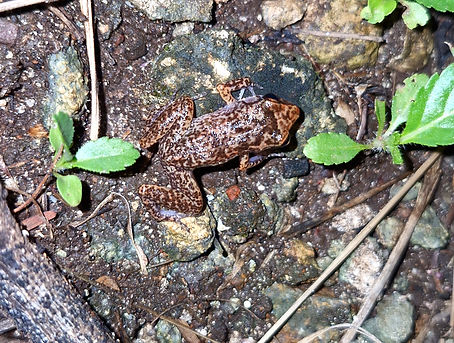
Cuban Flat-headed Frog
Unlike the Cuban Tree Frog, these two frogs do not have a tadpole stage. Instead, they lay eggs in moist soil, and the eggs hatch into miniature versions of adults.
The Bahama Flat-headed Frog is the only species endemic to The Bahamas.
People do not like frogs because of their slimy skin and weird look. Often, they throw salt on the animals, which causes severe irritation and dehydration, often leading to death. However, frogs are an essential group of animals in the Bahamian ecosystem. They feed on harmful and
pesky insects like mosquitoes and flies and are also a source of food for native animals like the Bahamian Racer, Bahamian Boa, Herons, Egrets, and other animals.
We do not have any native toads, salamanders, or axolotls in the Bahamas.


fact sheets

COMING SOON!
COMING SOON!
COMING SOON!
COMING SOON!

posters
The Bahamas hosts three native frog species: the Cuban Tree Frog, Cuban Flat-headed Frog, and the endemic Bahama Flat-headed Frog. The Cuban Tree Frog is the largest and exhibits sexual dimorphism, with females growing larger than males. It breeds during the rainy season, with females laying up to 15,000 eggs, and is an opportunistic predator known to eat insects, snails, and even other frogs, including its own kind. In contrast, the smaller Cuban and Bahama Flat-headed Frogs (genus Eleutherodactylus) bypass the tadpole stage, hatching directly into miniature frogs from eggs laid in moist soil. Although often misunderstood due to their slimy appearance, frogs are vital to the Bahamian ecosystem. They help regulate insect populations—especially mosquitoes—and serve as prey for native birds and snakes. Notably, The Bahamas lacks native toads, salamanders, and axolotls. Conserving these amphibians is crucial for maintaining ecological balance.
COMING SOON!
COMING SOON!
COMING SOON!

photo gallery
 |  |  |
|---|---|---|
 |  |  |
 |  |

resources
Eleutherodactylus planirostris. https://amphibiaweb.org/cgi/amphib_query?where-genus=Eleutherodactylus&where-species=planirostris&account=lannoo
Hedges, S.B., 1999. 4. Distribution Patterns of Amphibians. Patterns of distribution of amphibians: a global perspective, p.211.
Johnson, S., 2007. The Cuban Treefrog (Osteopilus septentrionalis) in Florida. Publication WEC, 218, pp.1-7.
McGarrity, M.E. and Johnson, S.A., 2009. Geographic trend in sexual size dimorphism and body size of Osteopilus septentrionalis (Cuban treefrog): implications for invasion of the southeastern United States. Biological Invasions, 11, pp.1411-1420.
Vargas-Salinas, F., 2006. Sexual size dimorphism in the Cuban treefrog Osteopilus septentrionalis. Amphibia-Reptilia, 27(3), pp.419-426.