


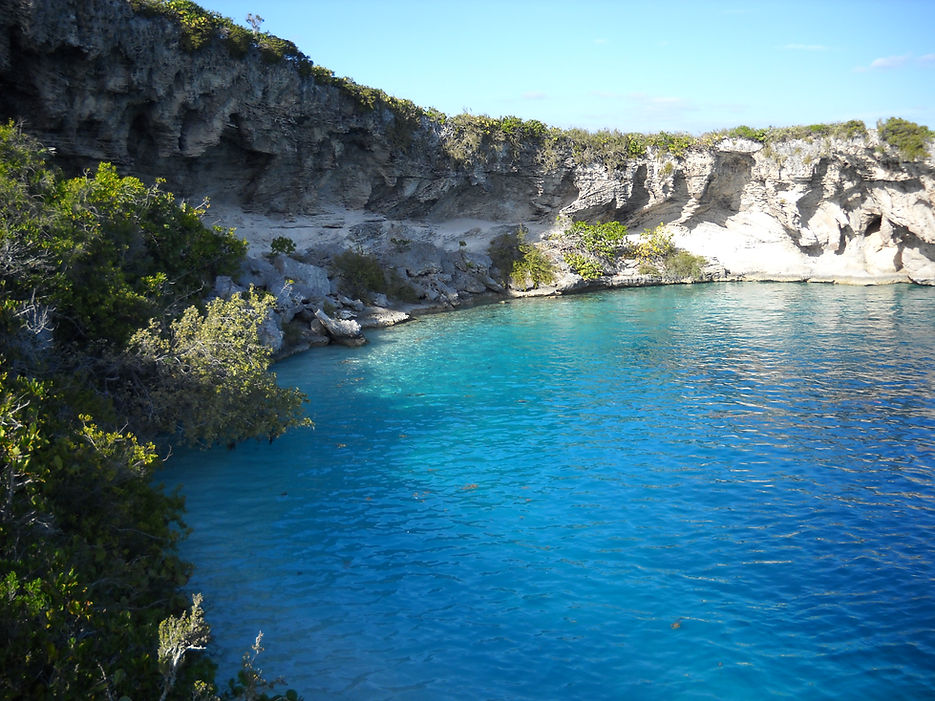
Deep, Dark Enigmas
Blue holes are some of the most famous forms of karst formations in The Bahamas. As defined by Mylroie, Carew, and Moore (1995), blue holes are “subsurface voids that are developed in carbonate banks and islands; are open to the earth's surface; contain tidally-influenced waters of fresh, marine, or mixed chemistry; extend below sea level for a majority of their depth; and may provide access to submerged cave passages.”

These formations were formed in several ways. One way in which they were formed is by the dissolution of limestone along a halocline (a vertical zone of salt water whose salinity changes quickly as you go deeper and that lies below a uniformly mixed saline water layer). Another way in which it forms is by water filling in a sinkhole or shaft that was formed by the dissolution of limestone. They can also be formed by a fracture along a bank margin or the progradational collapse of a deep dissolution void.

There are two types of blue holes: Saltwater and inland. Saltwater Blue holes are found in marine environments with tidal flow and inland blue holes are found away from areas influenced by surface marine conditions and often have a fresh or brackish water top layer, a salt water bottom layer and a halocline middle layer. These blue holes can be tidally influenced and may be connected to cave systems.
A lot of historical information has been found in Blue holes including fossils, climatic events and even changes in terrestrial plant communities. Blue holes are unique time capsules that should be cherished and protected. Unfortunately, in The Bahamas, blue holes are seen are dump sites and persons have dumped garbage in may of them, thus destroying the sensitive geochemistry and even animal species that may have resided in them.
Freshwater Blue hole- San Salvador
Captain Bills Blue hole- Andros


fact sheets

COMING SOON!
COMING SOON!
COMING SOON!
COMING SOON!

posters
COMING SOON!
COMING SOON!
COMING SOON!
COMING SOON!


photo gallery
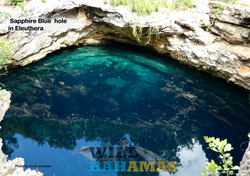 | 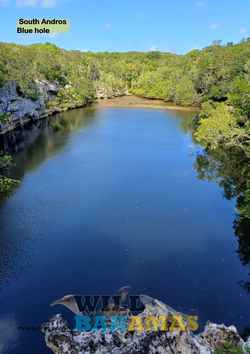 | 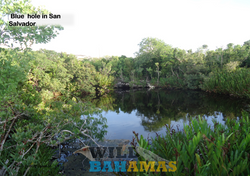 |
|---|

resources
Mylroie, J.E., Carew, J.L. and Moore, A.I., 1995. Blue holes: definition and genesis. Carbonates and evaporites, 10, pp.225-233.
Steadman, D.W., Franz, R., Morgan, G.S., Albury, N.A., Kakuk, B., Broad, K., Franz, S.E., Tinker, K., Pateman, M.P., Lott, T.A. and Jarzen, D.M., 2007. Exceptionally well preserved late Quaternary plant and vertebrate fossils from a blue hole on Abaco, The Bahamas. Proceedings of the National Academy of Sciences, 104(50), pp.19897-19902.
Winkler, T.S., van Hengstum, P.J., Donnelly, J.P., Wallace, E.J., Albury, N.A., D’Entremont, N., Hawkes, A.D., Maio, C.V., Roberts, J., Sullivan, R.M. and Woodruff, J.D., 2023. More frequent Hurricane passage across the Bahamian Archipelago during the little ice age. Paleoceanography and Paleoclimatology, 38(11), p.e2023PA004623.