


PREHISTORIC FOSSILS
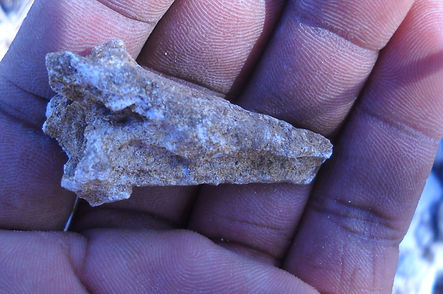
Fossilised conch shell fragment
The Bahamas has an interesting geological history. For hundreds of thousands of years, climate change has carved and molded our islands into the archipelago we see today. A lot of what we know about the environment of our islands in the past can be learned from the plants and animals that once lived here. Fossils are the remains of animals and plants that lived eons ago.
For something to be considered a fossil, it must be over 10,000 years old. Scientists use a number of methods to determine the age of fossils. One method is radiometric dating, which involves the understanding of radioactive decay of certain elements such as carbon or potassium to accurately date rocks containing fossils. Carbon exists as three isotopes: 12C, 13C and 14C. Carbon-12 (12C) has six protons and six neutrons in its nucleus, Carbon-13 (13C) has six protons and seven neutrons and Carbon-14 (14 C) has six protons and eight neutrons. Although 12C and 13C are stable,14 C is not and is radioactive. This means that it can change the number of protons or neutrons (or both), a process called radioactive decay and form a stable element 14N (Nitrogen-14). The isotope that decays, in this case 14C, is called the parent isotope and the one that forms from the decay (14N) is called the daughter isotope. Research into radioactive decay show that many radioactive isotopes rate of decay do not change over time, making them useful in helping to determine the age of a rock or fossil.
In The Bahamas, many fossils of terrestrial animals have been found, with none dating older than about 31,000 years. The majority of these significant finds have occurred in distinct geological formations such as caves, blue holes, and banana holes scattered across The Bahamas. Notable examples include Banana Hole on Western New Providence, named for the banana tree discovered at the site, and Sawmill Sink, a blue hole situated in South Abaco. These locales stand as testaments to the wealth of information embedded in the fossilized remnants of past life, offering a captivating glimpse into the natural history of The Bahamas.
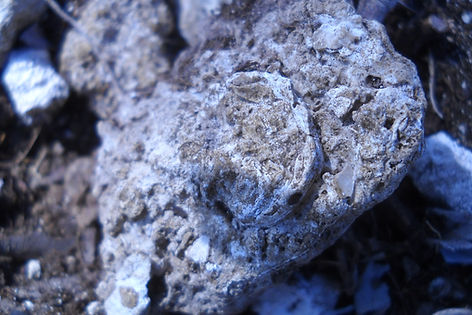
Fossilised shell embedded in rock
