


Beyond their native shores
It is important to recognize that not all introduced species have the same ecological status. Some have not been observed to harm the Bahamian environment and are simply classified as "exotic." The Bahamas is home to numerous non-native animal species, ranging from various invertebrates, mammals, amphibians, reptiles, and birds. While many of these species are not currently considered invasive, their ecological impact remains uncertain due to a lack of research on their behavior and biology. Here are a few species that are considered exotic in The Bahamas.

Exotic birds of The Bahamas:
-
Ring-necked Pheasant (Phasianus colchicus)
-
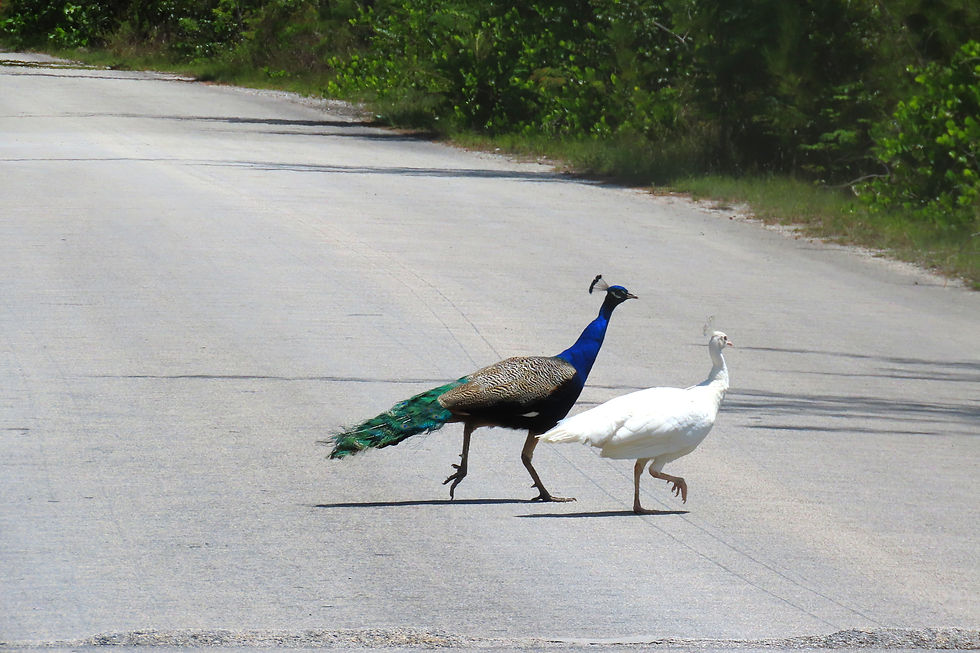
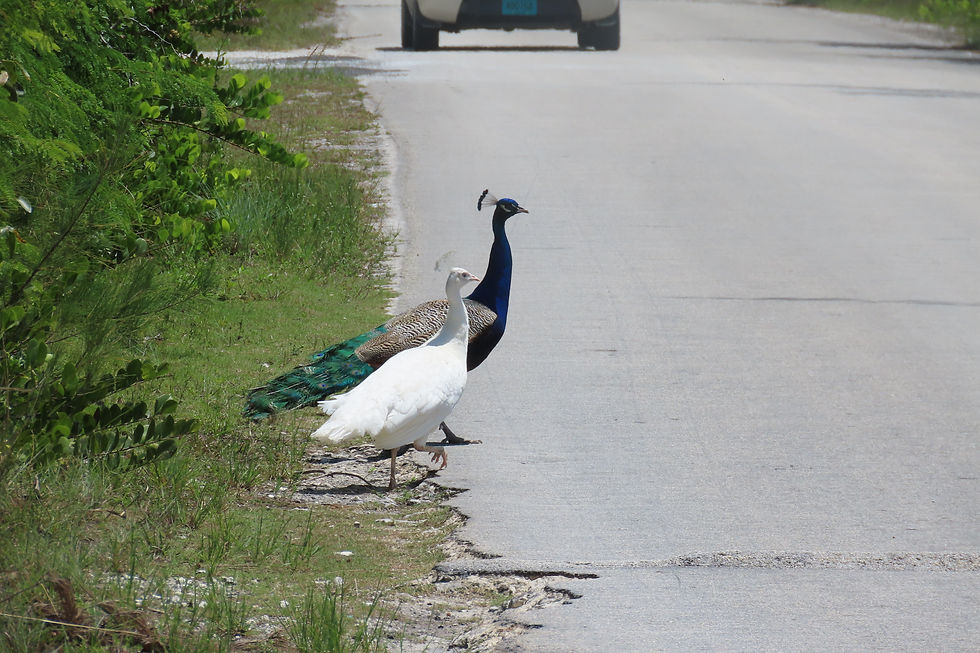
Common or Indian Peafowl (Pavo cristatus)
-
Northern Bobwhite Quail (Colinus virginianus). Introduced in the late 19th century.
-
Caribbean Dove (Leptotila jamaicensis) (Jamaican subspecies introduced to New Providence in the 1920s)
-
Cuban Grassquit (Phonipora canora)
-
Pied Imperial-Pigeon (Ducula bicolor). Introduced onto New Providence in 1996.
-
Sulfur-crested Cockatoo (Cacatua galerita)
-
Muscovy Duck (Cairina moschata)
-
Monk Parakeet (Myiopsitta monachus). First record in Eleuthera in 1980, then Grand Bahama.
Cuban Grassquit
In March 1963, an airplane transporting 600 "Cuban Finches" from Cuba to a European zoo made an emergency landing in Nassau. The unexpected delay resulted in the deaths of approximately 200 birds. Most of the survivors were released, including around 300 "Melodious Grassquits," which were set free on New Providence.
Since then, the Cuban Grassquit has successfully established itself on the island, frequently spotted in residential areas where it feeds on grass seeds from both native and introduced plant species.
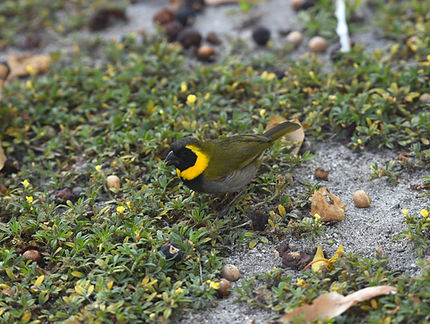
Cuban Grassquit
As its name suggests, the Cuban Grassquit is a small, finch-like bird native to Cuba. It has a black face with a yellow band that starts from behind the eye and curves around the face, forming a yellow bib that rests on the chest. The upper body is green and the belly is grey with a black breast. While details of its introduction to The Bahamas vary, Brudenell-Bruce (1975) recounts one widely accepted version of the story:
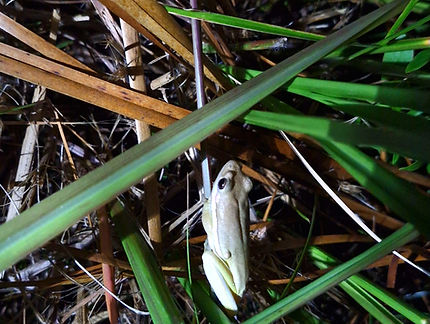
American Green Tree Frog
The American Green Tree Frog (Hyla cinerea) is a small tree frog native to the southeastern United States, commonly found in both natural and artificial wetland habitats. Measuring about 1 to 2 .5 inches in length, it varies in color from bright green to yellowish-green or greenish-gray. A distinctive white or cream-colored stripe runs from the side of its head down to its flanks.
The species was first recorded in The Bahamas at Bonefish Pond National Park in 2015.
Since then, it has been observed at Lyndon Pindling International Airport and Old Fort Bay Plaza in western New Providence. To date, it has not been documented outside of New Providence. Vessels carrying plant products from ports in the US, such as Florida are the likely means by which this species entered the country.
Corn Snake
The Corn Snake (Pantherophis guttatus), also known as the Red Ratsnake, is a medium-sized, nocturnal colubrid native to the southeastern United States. It typically grows to about 127 cm but can reach lengths of up to 180 cm. Unlike Bahamian snakes, it has a distinctive black-and-white checkerboard pattern on its belly and a brownish upper body marked with red, orange, or brown blotches. Non-venomous, it subdues its prey through constriction but may bite if threatened. It was first documented in The Bahamas in the 1990's.
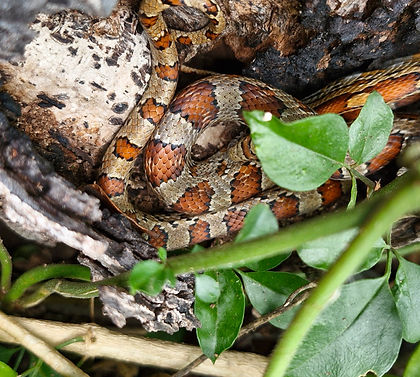
Corn Snake
Although considered invasive, the true impact of Corn Snakes in The Bahamas remains uncertain, as no studies have been conducted to assess their ecological effects. However, the species is spreading, with populations recorded on Grand Bahama, Abaco, New Providence, and, more recently, North Andros. It preys on lizards, rodents, and possibly birds, though no bird predation has been observed in The Bahamas. Studies in the United States indicate that Corn Snakes consume nestlings at night.
American Green Tree Frog
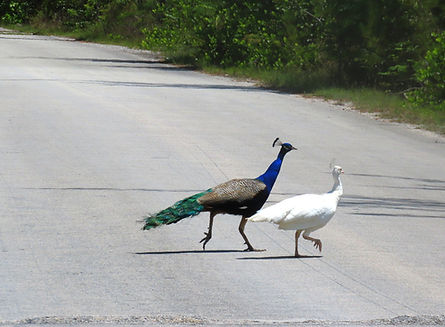
Common Peafowl seen in Abaco
Pied Imperial-Pigeon


fact sheets

COMING SOON!
COMING SOON!
COMING SOON!
COMING SOON!
posters
COMING SOON!
COMING SOON!
COMING SOON!
COMING SOON!
photo gallery
 |  |  |
|---|---|---|
 |
resources
Brudenell-Bruce, P.G.C. 1975. The Birds of New Providence and The Bahama Islands. Collins Clear-Type Press. London and Glasgow
DeGregorio, B.A., Weatherhead, P.J. and Sperry, J.H., 2016. Ecology and predation behavior of corn snakes (Pantherophis guttatus) on avian nests. Herpetological Conservation and Biology, 11(1), pp.150-159.
Giery, S.T., 2013. First records of Red Cornsnakes (Pantherophis guttatus) from Abaco Island, The Bahamas, and notes on their current distribution in the greater Caribbean region. Reptiles & Amphibians, 20(1), pp.36-39.
Johnson, S. and Woods, D., 2016. First record of Red Cornsnakes (Pantherophis guttatus) on Andros Island, The Bahamas. Reptiles & Amphibians, 23(3), pp.187-187.
Johnson, S. and Yates, S.S., 2020. First records of the North American Green Treefrog (Hyla cinerea) on New Providence, The Bahamas. Reptiles & Amphibians, 26(3), pp.257-258.
Pham, L., Boudreaux, S., Karhbet, S., Price, B., Ackleh, A.S., Carter, J. and Pal, N., 2007. Population estimates of Hyla cinerea (Schneider)(green tree frog) in an urban environment. Southeastern Naturalist, 6(2), pp.203-216.
https://www.floridamuseum.ufl.edu/florida-snake-id/snake/red-cornsnake/